
Yes, an exterminator is worth it once mice have settled into your home: you’re finding droppings every day, they’ve reached the bedrooms, or you hear them in the walls or the attic. At that point you’re dealing with a colony and several ways in, not one stray mouse.
If you saw a single mouse in the garage once, you may be able to handle it yourself. But most people who call us have already spent weeks, sometimes months, on store-bought poison, traps and foam. The mice are still there, and the entry points are still open.
This article explains how to tell which situation you’re in, why DIY mouse control so often fails, what a professional treatment includes, and a real job from Westmount that shows the difference.
When you can handle it yourself, and when to call a professional
In my experience, the line is clear. Once mice reach your living space, such as the bedrooms, or you hear them in the walls or the attic, it’s time to call an exterminator. By then they’re nesting inside the structure of the house, where traps on the floor won’t reach them.
| You can probably try DIY first | Call a professional |
|---|---|
| You saw one mouse, once | You find fresh droppings every day, in several rooms |
| The signs are limited to the garage or a shed | Mice have reached the kitchen cupboards or the bedrooms |
| You found a few old droppings and nothing new since | You hear scratching or running in the walls, ceiling or attic every day |
| You can see exactly where it got in | You’ve already tried poison, traps or foam and they’re still coming |
| You live in a detached house with no attached units | You live in a plex or apartment building with shared walls and pipes |
The signs that tell me an infestation is bigger than the customer thinks are droppings everywhere, every day and noise in the walls every day. One mouse doesn’t leave droppings in the kitchen, the basement and the bedroom closet. And mice breed fast, so a problem you wait out through the fall is usually a bigger one by winter.
Why DIY mouse control so often fails
Most of the homes we visit have already tried something. These are the three mistakes I see most often.
1. Store-bought poison
Many mice are already resistant to the common poisons. In one study of house mice in Finland, two out of three carried a genetic mutation linked to resistance to anticoagulant rodenticides, the most common type of mouse poison (Aivelo et al., International Journal of Pest Management). In Canada, the products sold to homeowners can’t contain the stronger second-generation anticoagulants (Health Canada). So people put out bait, the mice eat it, and nothing changes.
Poison also doesn’t close a single entry point. Even when it kills some mice, new ones keep coming in the same way.
2. Snap traps alone
Snap traps catch the mice that walk into them. They do nothing about the nest in the wall, the mice you never see, or the gap they use to get in. A trap that catches one mouse a week can feel like progress while the population keeps growing.
3. Sealing holes with regular expanding foam
This is the one I see most in Montréal homes. Regular expanding foam is soft, and mice chew right through it. Within a few weeks the hole is open again, and now it’s hidden behind foam that looks sealed. Our Westmount case below is exactly this.
The common thread: DIY usually treats the mice you can see. Getting rid of mice for good means finding how they get in and closing it with materials they can’t chew through.
What a professional mouse treatment includes
The difference between a professional job and DIY is that we treat the whole problem: the mice inside, the mice still outside, and the openings between them. This is how our team handles every mouse job.
- Phone assessment. We ask what you’ve actually found. Did you see a mouse, hear something in the walls, or only find droppings? Where, and since when? This tells us how established they are before we arrive.
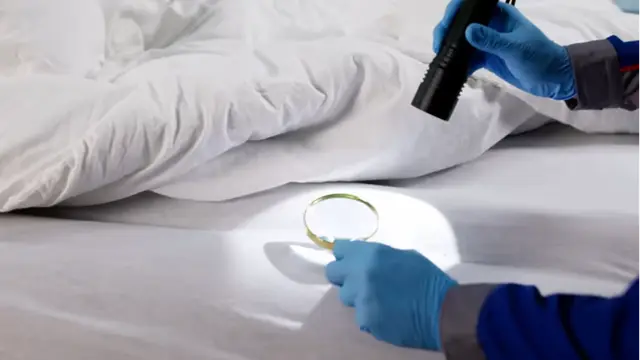
- Inspection inside and outside. The technician inspects the whole property: the basement, the attic, the garage, the kitchen and every spot where pipes or wires come through a wall. Outside, he checks the foundation, siding, vents, the roofline and around doors. The goal is to find every entry point, not just the one you noticed.
- Assessment and plan. The technician puts the picture together: how many entry points, where the mice are nesting and how far they’ve spread. Then he explains what he found and what he’ll do.
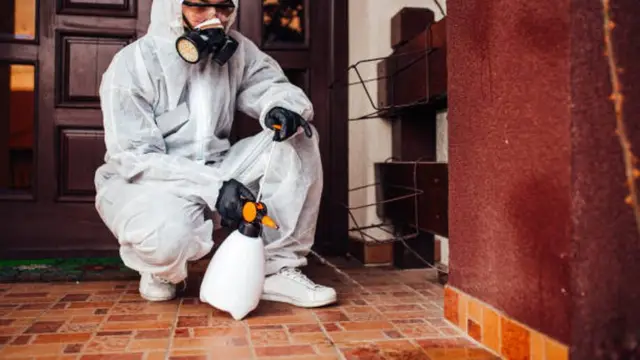
- Baiting in locked stations, inside and outside. We place bait stations strategically along the routes mice travel, both inside the home and around the outside. The bait is inside locked, tamper-resistant boxes that children and pets can’t open.
- Blocking the entry points. We close the major entry points with materials mice can’t chew through: copper mesh, Xcluder rodent-proof fabric, rodent-proof caulking and foam. Copper mesh doesn’t rust like steel wool, and mice can’t chew through it the way they chew through regular foam.
- Follow-up visit. Most jobs take 1 to 2 visits, 3 to 4 weeks apart. On the follow-up, the technician checks the bait stations, inspects the sealed entry points and looks for any new activity.
We consider the job done when you’ve stopped finding new droppings and stopped hearing them in the walls.
Case study: the Westmount house sealed with expanding foam
A homeowner in Westmount had mice and decided to fix it himself. He found the holes he could see and filled them all with regular expanding foam from the hardware store.
For a few weeks it seemed to work. Then the mice started chewing through the foam and coming back in, and that’s when he called us.
What we found: the mice had chewed through the foam at the openings he’d sealed. Our inspection also turned up more entry points he hadn’t found.
What we did:
- Removed all of the expanding foam.
- Sealed every opening properly with rodent-proof materials, including the new entry points we’d found.
- Placed locked bait stations to deal with the mice already inside.
The result: within 3 weeks, he stopped seeing mice.
This is why I tell people a professional is usually worth it. He didn’t fail because he didn’t try hard. He failed because foam isn’t a barrier to mice, and because the openings you can see are rarely all of them. Weeks of DIY ended up costing him more time, and part of our work was undoing it.
Where mice get into Montréal homes
Mice don’t need much room. Public health guidance is to seal any exterior opening larger than 6 mm (1/4 inch) (HealthLinkBC). In Montréal, the homes with the most mouse problems are the ones with the most of those openings:
- Old plexes. Decades of settling, repairs and renovations leave many small gaps in foundations, around windows and where additions meet the original building.
- Attics. Gaps at the roofline, soffits and vents let mice in from above.
- Unfinished basements. Gaps where pipes, wires and the gas line come through the foundation, and cracks in old stone or concrete.
- Garages. Worn door seals and the gap between the garage and the house.
In apartments and plexes, it’s a building problem
In a building, mice travel along the plumbing. The pipes are interconnected through every unit, so mice move from one apartment to the next inside the walls. That’s why we also inspect the adjacent units. Treating one apartment while the neighbours’ entry points stay open just sends the mice next door, and back again.
What you can do yourself
- Find and block entry points with copper mesh. This is the single most useful thing a homeowner can do. Push it firmly into gaps around pipes and cracks. Skip regular expanding foam: mice chew through it.
- Store food in sealed containers, including pet food and birdseed, and don’t leave food out on counters overnight.
- Clear clutter in the basement and garage, where mice nest in boxes and stored items.
- Clean up droppings safely. Don’t sweep or vacuum them, because that puts particles in the air. Wear gloves, spray the droppings with a disinfectant or a mix of 1 part bleach to 9 parts water, let it soak for 10 minutes, then wipe up with paper towels (Public Health Agency of Canada).
Safety, cost and guarantee
Is a professional treatment safe for kids and pets?
Yes. We use products approved by the Government of Canada, applied exactly as the label directs. All bait goes into locked, tamper-resistant stations that only our technicians can open, so children and pets can’t reach it.
That’s a real difference from DIY. Health Canada calls rodenticides “highly acutely toxic compounds” and has added rules specifically to protect children, pets and wildlife from them (Health Canada). Poison tucked behind the fridge or under the sink is how accidents happen.
What does it cost?
We don’t publish fixed prices, because every home is different. The cost depends on:
- the size of the property and how many floors and units it has
- how many entry points need to be sealed, and where (a basement gap is quicker than a roofline)
- how established the infestation is
- whether it’s a house, a plex or a commercial building
The estimate is free. When you compare cost, count what DIY is already costing you: bait and traps that don’t work, weeks of droppings to clean up, and damage to insulation, wiring and stored belongings.
Our guarantee
Our mouse treatments come with a guarantee of 3 months to 1 year, depending on the service. If the mice come back during that time, so do we.
Frequently asked questions
How long does it take an exterminator to get rid of mice?
Most jobs take 1 to 2 visits, 3 to 4 weeks apart. In our Westmount case, the homeowner stopped seeing mice within 3 weeks once the entry points were sealed properly and the bait stations were in place.
Will mice go away on their own?
No. Once they’ve found food, warmth and a way in, they stay and they breed. The longer you wait, the more mice and the more damage there is to deal with.
Are mice dangerous?
They can be. Mice spread hantaviruses mainly through their droppings, urine and saliva, and people can be infected by breathing in particles when droppings or nests are disturbed (Public Health Agency of Canada). They also contaminate food and chew insulation, wiring and stored belongings.
Why do I still have mice after using poison?
Two reasons. Many mice are resistant to common poisons, and poison doesn’t close the openings they use, so new mice keep coming in.
Do I need to leave my home during treatment?
No. The bait is sealed inside locked stations, and the sealing work doesn’t require you to leave.
Is it worth it to use an exterminator for just one mouse?
If you’re sure it was a single mouse, in the garage or a shed, and you find no fresh droppings afterwards, try sealing the gap with copper mesh first. If you see one in the kitchen or the bedroom, there are almost always more.
The bottom line
If you’re finding droppings every day, hearing mice in the walls or attic, or they’ve reached your bedrooms, an exterminator is worth it. You’ll get rid of them faster, the entry points get sealed with materials that last, and the bait stays locked away from your family and pets.
Call us at 514-531-6074 or request a callback. We answer 24/7, in French and English, and the estimate is free. Learn more about our mouse and rat extermination service.
Sources
- Prevention of a hantavirus infection, Public Health Agency of Canada
- Questions and answers: additional mitigation measures for rodenticides, Health Canada
- Getting rid of rodents (rats and mice), HealthLinkBC
- VKORC1-based resistance to anticoagulant rodenticides widespread in Finnish house mice but not in brown rats, Aivelo et al., International Journal of Pest Management, 2023